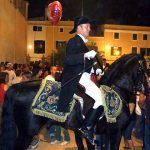
The Sant Joan festivities will take place in Ciutadella (Ciudadela) on 23 and 24 June. This is one of the most important and eagerly awaited celebrations, welcomed with great joy and excitement, bringing together thousands of people every year.
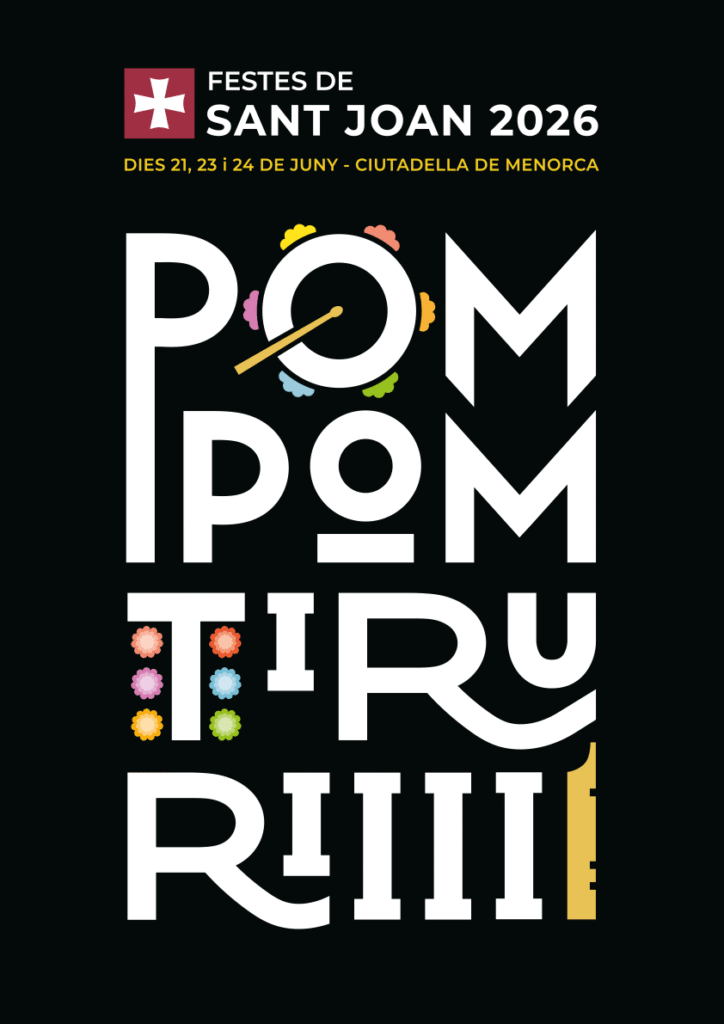
History and Protocol
The festival’s roots are deeply religious, originating at the rural chapel of Sant Joan de Missa, located 3 kilometers from Ciutadella
Dating back to the early 14th century, an annual pilgrimage to the small chapel of “Sant Joan de Missa” was organized by the saint’s guild. Members of this brotherhood traveled on horseback alongside family and friends to honor their patron saint, John the Baptist.
This brotherhood represented the core pillars of traditional Menorcan society, making up the “Caixers” (Riders) Board. 
Today, this board is tasked with upholding the festival rules and protocols, ensuring the proper conduct of all members in the “qualcada” (cavalcade), and guaranteeing that all scheduled events run smoothly.
The caixers on the board include the caixer senyor (nobleman), the caixer capellà (chaplain), the caixer casat (married artisan), the caixer fadrí (bachelor artisan), and the caixers pagesos (farmers), representing the north and south of the municipality.
2026 Festival Program
Explore the main events of the festival below (all times are approximate).
• June 21st: The Atmosphere Builds
The festivities kick off on the eve of “Diumenge des Be” (Sunday of the Lamb), though they officially commence at 9:00 AM with the “primer toc de fabiol” (the first notes of the flute) at the caixer senyor’s palace.
The festive energy builds the night before, when the lamb is presented at the caixer pagès’s home. It is traditionally hosted in a ground-floor garage open nearly all night, drawing crowds of locals—especially children, who are always the first to arrive.
• June 22nd: “Diumenge des Be” (Sunday of the Lamb)
“Diumenge des Be” always takes place on the Sunday before Sant Joan
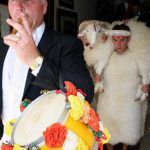
Early in the morning, around 8:00 AM, the “home des be” (Man of the Lamb)—a local farmer dressed in sheepskins representing John the Baptist—prepares to set off. Carrying the live lamb on his shoulders, he leaves the caixer pagès’s house accompanied by the festival board (excluding the caixer senyor and the chaplain).
9:00 AM: The “Primer Toc”
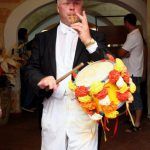
The festival officially begins with the “primer toc de fabiol” (the first notes played on the drum and wooden flute) by the fabioler at the Caixer Senyor’s Palace, signaling the departure of “s’homo des be” and his procession.
Throughout the day, the procession winds through the streets of the Old Town, visiting the Town Hall, the Bishop’s Palace, and the Des Born Theatre—where the traditional “Foc i Fum” zarzuela is performed. They also stop at the geriatric hospital, local social clubs, historic manors, and the homes of local noblemen to invite them to the upcoming festivities on June 23rd and 24th.
Around 8:00 PM: Hazelnut Throwing
While the procession visits noble homes, the tradition of throwing hazelnuts takes over Avenida de la Constitución, known as “Sa Contramurada“, accompanied by the Ciutadella municipal band. This highly anticipated moment is a favorite among children; though it turns into a lively free-for-all, the hazelnuts are thrown playfully and safely, as the event is a true expression of love and joy.
Once the scheduled visits wrap up, the traditional “beguda de caixers” takes place, where the riders gather for refreshments at the caixer casat’s home. Afterward, the caixer senyor and caixer capellà take their leave, bringing the day’s events to a close later that evening.
• June 23rd: Dissabte de Sant Joan (Saint John’s Eve)
2:00 PM: “Primer Toc” at the Caixer Senyor’s Palace
On Sant Joan’s Eve, at exactly two o’clock in the afternoon, the “fabioler” requests permission to begin the festivities at the palace of the Caixer Senyor, who presides over the festival for the current two-year term. This massive gathering erupts with emotion the moment the “fabiol” flute sounds for the first time. This iconic melody will guide the entire festival, setting the pace for every event to follow.
Next, the “replec” begins as the fabioler leads the way to gather the remaining members of the “qualcada“. Once the full cavalcade of horsemen has formed, the Sant Joan flag is officially handed over to the caixer fadrí—who will proudly carry it throughout the celebrations—by the bachelor rider’s wife. The last to join the qualcada are the caixer capellà and the caixer senyor.
6:00 PM: Caragol des Born
The “Caragol des Born” takes place in Plaça des Born, where over a hundred riders and their horses elegantly rear and dance to the rhythm of the “jaleo“—the iconic traditional music of Menorca’s patron saint festivals.
7:30 PM: Mass at the Sant Joan Chapel
Afterward, they make their way in pilgrimage to the small chapel of Sant Joan de Missa, roughly 3 km from Ciutadella, where a mass is held in honor of the patron saint. Afterward, the riders stop for light refreshments to recharge. As night falls, the horsemen ride back to town. Meanwhile, at 7:00 PM, the playful hazelnut battle resumes along Avenida de la Constitución (“Sa Contramurada”) and Plaça de ses Palmeres.
9:00 PM: Caragol de Ses Voltes
Once all the horsemen have returned to town, the “caragol de ses voltes” begins—a slow procession through the beautiful, narrow medieval streets of the city center, following the street known as “Ses Voltes.”
10:00 PM: Ses Corregudes
The procession then moves through the Plaça de la Catedral, where the traditional “Corregudes” (horse races) take place.
11:00 PM: Caragol de Santa Clara
The riders arrive at the Santa Clara convent (Caragol de Santa Clara) around 11:00 PM.
Afterward, they bid farewell to the caixer capellà and caixer senyor in front of their respective homes. This is followed by the traditional “beguda de caixers” (refreshments for the riders) at the Caixer Senyor’s palace and the final departure (on foot) of the Caixer Capellà. The festivities continue into the early hours of the morning.
• June 24th: Diada de Sant Joan (Saint John’s Day)
8:00 AM: Primer Toc
Sant Joan’s Day begins at 8:00 AM, when the “fabioler” requests permission at the Caixer Senyor’s palace to start the day’s gathering. They then head to the caixer casat’s home to retrieve the flag left there the previous day.
Following the same order and protocols as the day before, the following events take place:
Corregudes a sa Plaça (Ses Voltes)
1:30 PM: Caragol de Santa Clara.
2:30 PM: Missa de Caixers
Arrival at the Cathedral for the celebration of the Missa de Caixers (Riders’ Mass), followed by refreshments for the riders at the Caixer Capellà’s home.
5:00 PM: Replec 
The cavalcade reforms on Carrer de Sant Jeroni and Carrer de Sant Francesc to carry out the following events:
Invitation by the Caixer Senyor to the council members at the Town Hall balcony, where they are welcomed by local authorities, followed by their descent to the port to attend the games.
Afterward, they head to the Santa Clara convent for a “caragol” involving the caixers casats and the Caixer Senyor’s request to the nuns.
7:00 PM: “Jocs des Pla” (Medieval-style Tournaments)
The “Jocs des Pla” consist of a series of skill-based challenges rooted in medieval tournaments. This is one of the most significant, spectacular, and crowded events of the Sant Joan festival. They are held at “Es Pla,” the esplanade at the Ciutadella port.
Caragol des Pla
Upon arriving at the port, the riders begin the “Caragol des Pla.” During this procession, the caixers, mounted on their decorated horses, complete several laps to the rhythm of the Jaleo, performed by the magnificent Ciutadella municipal band.
Following the jaleo, the “Jocs des Pla” begin with the following trials:
Breaking the “carotes.”
One of the most thrilling and iconic events of the day.
The “carotes” are traditional oval wooden shields featuring hand-painted caricatures of local figures. Two riders gallop forward; one carries the shield, and the other must break it with a small red clay pitcher. After the run, the local youths scramble to collect a piece of the shield as a souvenir trophy.
Correr l’ensortilla
Another highlight is the “ensortilla.” Riders gallop toward a suspended ring, attempting to spear it with a lance. If successful, the band plays a traditional festival song, prompting the crowd to break into dance.
“Winners of each trial are awarded a green reed and a silver spoon.”
Correr abrazados
In this trial, two riders (often family members, such as father and son, brothers, or cousins) gallop side-by-side, aiming to embrace and kiss each other on the cheek as they pass, to the applause of the crowd.
Caragol des Pla
After the trials, the “Caragol des Pla” is repeated to the rhythm of the Jaleo.
11:00 PM: Corregudes a la Plaça
Once the games conclude, they head to the Plaça de la Catedral and Carrer Ses Voltes to perform the final “ses corregudes.”
12:00 AM: Caragol de ses voltes
12:30 AM: Caragol de Santa Clara
Farewell ride of the caixer capellà and caixer senyor.
They drop off the Caixer Senyor and enjoy final refreshments at his palace.
5:00 AM: Darrer toc de fabiol
The final notes are played at the Sant Antoni Maria Claret parish (55 Pere Cortès Street), marking the end of the festival. Here, you can hear the traditional closing phrase: “Fins l’any vinent si Déu vol!” (Until next year, God willing!).
• June 25th (Festival Finale)
11:30 PM: Fireworks
To wrap up the festivities, a spectacular fireworks display will be launched from Plaça des Born, visible from throughout the city. The night will also feature a free concert by Cris Juanico.
More Information on the Festivities
ℹ️ Find more information here 👉 about Menorca’s patron saint festivals, their traditions, and protocols.
🏛️ At the Can Saura Museum in Ciutadella, you can visit a magnificent permanent exhibition on the festival, which also includes an interesting documentary shown in their screening room.
👉 Safety tips and recommendations for the Sant Joan festival.
Menorca’s Patron Saint Festival Calendar
The next festival is Sant Martí in Es Mercadal.
Check the 📅 Patron Saint Festival Calendar for other towns in Menorca.

Sant Joan Photo Gallery