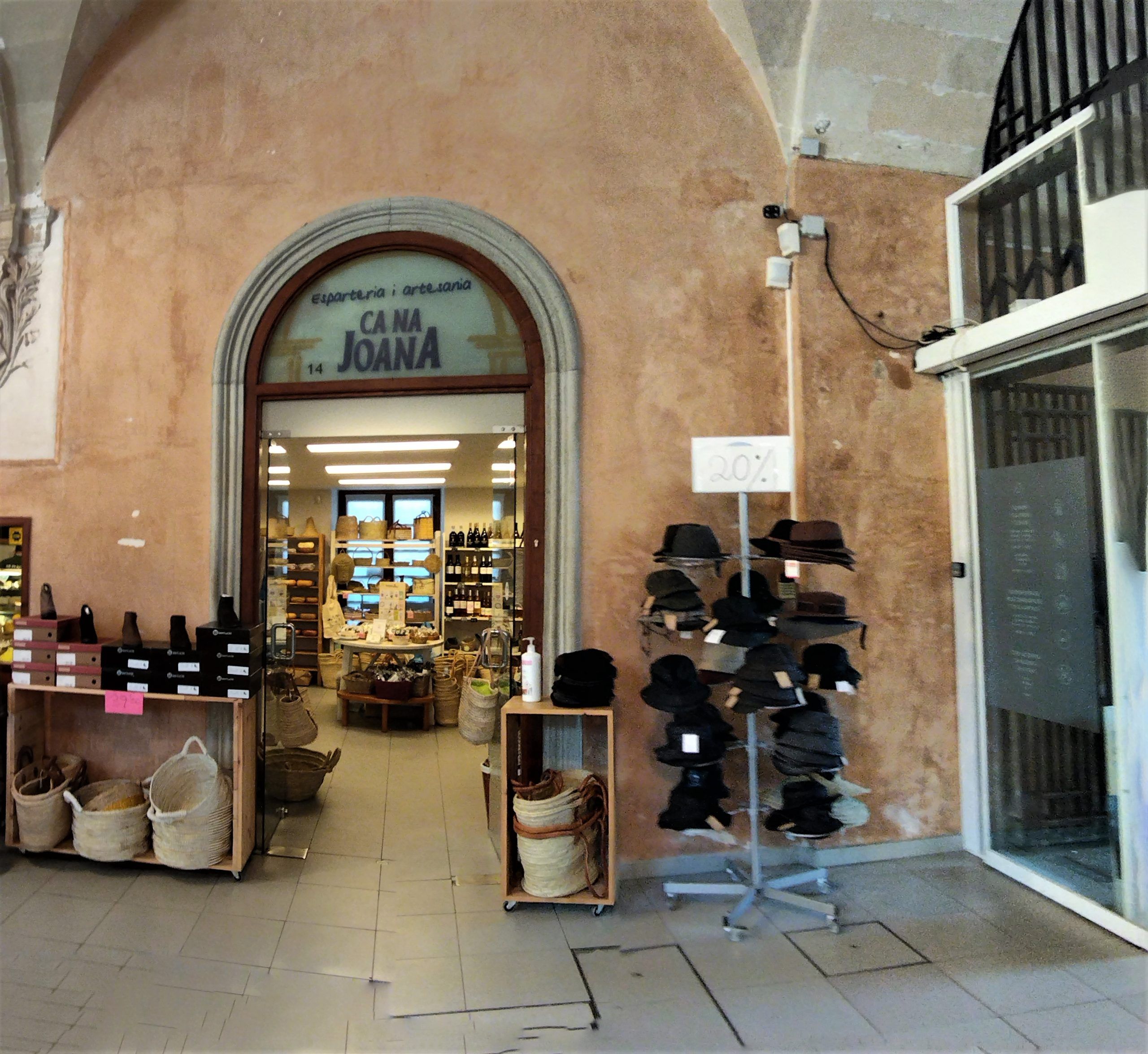
The Claustro del Carmen Market is located in an ancient 18th-century Carmelite convent right in the city’s historic center. It features a cultural space where numerous cultural events and open-air concerts are held.

Índice de contenidos
- The Market
- Information of Interest
- Cultural Space
- Open-Air Concerts – Summer Schedule
- History
- › The Carme Convent
- › New Uses for the Convent
- › The Palace of Justice
- › The Prison
- › The Civil Guard
- › The School
- › From Ancient Markets to the Current Market
- › Cultural and Educational Services
- How to get there
- Information and Opening Hours
- What to do in Mahón
- Leisure Activities – Guided Tours
- Image gallery
The Market
The Claustre del Carme Market housed Carmelite monks until its secularization in 1835. It features sober yet elegant lines, with a notable set of decorated corbels.
 Currently, it hosts the market on the ground floor and cultural facilities on the upper floor, where exhibitions and various cultural activities take place.
At the Carmen Market stalls, you will find all kinds of artisanal and locally produced goods.
There are fruit and vegetable stalls, food shops where you can find products like the famous Mahón cheese or the Menorcan ensaimada, and craft shops selling all sorts of items such as the typical Menorcan abarcas (sandals), as well as excellent butcher shops offering Menorcan meat and traditional cold cuts like sobrasada or cuixot.
The market also has a supermarket in the basement next to the parking lot.
More information on the market’s website: mercatdesclaustre.com.
Information of Interest
- There is a 24-hour parking lot with access from Plaza Miranda.
- You can take the opportunity to visit the Mercat des Peix (fish market) located in the same square.
- Behind the market, there is a practical elevator to go up and down to the Port of Mahón, offering spectacular views. Don’t forget your camera!
Cultural Space
Open-Air Concerts – Summer Schedule
The Claustre del Carme features a terrace and a cultural space where various cultural events are organized, especially during the summer months when numerous concerts are scheduled featuring some of the best national and international groups and artists.
You can find the full schedule and times on the website: esclaustre.com.
History
› The Carme Convent
The first efforts to establish the order of the Calced Carmelites on the island date back to the late 17th century. According to chronicles, after the creation of a hospice was approved in 1693, two or three religious members occupied some caves in the cliffs facing the Portal de Mar, which they used as living quarters and a space for teaching.
Anastasi Strader from Mahón, who had professed at the Carme Convent in Barcelona in 1655, sold a family house they owned in Pla de sa Parròquia and dedicated the proceeds to buying another in what is now Plaza del Carme, very close to the current entrance of Sa Plaça. It is here where the Carmelites created the first hospice, the community’s house, where they also provided education.
Public Oratory
Shortly after, the religious members asked to open a public oratory, a wish that met with opposition from the Franciscans, who were jealous of their presence in Mahón, as well as from part of the clergy and the population. They had to wait until 1701 to open this tiny chapel of 25 square meters. Even so, pressure from their opponents caused it to close in 1702, and it did not reopen until 1705.
The Carmelites did not yield in their intentions to build a convent (with a church) in Mahón. In 1725, Pope Benedict XIII granted them the status of a monastery, and construction began. However, the Franciscans and the English Governor Richard Kane opposed it once again, and the works were halted.
Support from the New English Governor, Sir William Blakeney
Construction remained halted between 1728 and 1744. It was in the latter year that they received support from the new English Governor, Sir William Blakeney, but they still had to wait until 1750 to obtain the Royal License from His British Majesty. None of what they had previously built was useful, and they had to start anew.
In 1750, the first stone was blessed. Although they began at the same time, the church works were blessed in 1754, whereas the convent was not finished until 1781. And even then, the entire east wing was left half-completed.
Present Day
Currently, the visibility of the architectural complex in the city is very limited due to the surrounding and nearby buildings. However, originally, as an isolated building, it dominated the city due to its large volumes and its elevated, distinguished position, especially when viewed from the port of Mahón.

The original square-plan convent, with the largest courtyard among those located in Menorca, is distributed over two levels: on the ground floor, the north and west wings housed the cells of the religious members, the kitchen, the refectory, and some storage. The east wing, uncovered, was a space dedicated to stables, warehouses, and enclosures.
The south wing is unusable as it forms a party wall with the church. In the northeast corner, there is a water wheel and a small cistern that provides water to the convent. On the upper floor, only the north and east wings are occupied, used as cells, a library, the prior’s room, and the chapter house.
The ensemble of the church and convent is a fine witness to austere Neoclassicism in Menorca. Regarding the convent, numerous subsequent interventions have damaged it from an architectural point of view. Ornamentally, we highlight the twenty large corbels in the north and west corridors, the work of sculptor Ferran Miguel Comas.
Departure of the Friars
The Carmelite friars had little time to enjoy the convent they had worked so hard to build. Forty years after its inauguration, during one of those liberal waves sweeping Spain in the early 19th century, the convent passed to the State and they were expelled. As we know, waves come and go, and just two years later, during an absolutist period, the friars returned.
It was with the so-called Mendizábal Disentailment (1835) when the religious members finally abandoned the building. At that time, twenty people lived there. Some stayed in Mahón. The prior, Joan Brocardo Cardona, moved to Alaior. Others began a process of secularization, and the rest left the island for other Carmelite communities.
› New Uses for the Convent
› The Palace of Justice
Since the early 19th century, Mahón had demanded decent judicial facilities. Governor Ramírez defended the creation of new Courts and a prison where the Miranda square viewpoint is now located. From 1838, the City Council allocated part of the building for judicial premises on a temporary basis.
In 1881, due to the building’s degradation, the City Council launched the creation of a Palace of Justice, which did not succeed due to a lack of funding. For some years, the municipality had to rent private properties for these purposes.
Construction
In 1888, a failed project was presented to create the Palace of Justice in what we now know as Plaza Colón, which would have made the square disappear.

At the end of the 19th century, the great undertaking of building a Palace of Justice in the Carme Convent was launched. We say “building” because it was decided to act on the east corridor, which had no upper floor and part of which was uncovered, where the market’s stables and service warehouses were located.
This was a high-impact project resulting in what is now the Hearing Room and what had been the Hernández Mora Collection-Museum.
In this entire wing, the different departments of the Justice Administration and the Judicial archives of Mahón were distributed, and later, the headquarters of the Property Registry. This use continued until around 1983 when, facing the threat of collapse, a hasty move was made to the building known as “of the unions” in the same Plaza Miranda.
› The Prison
An immediate use of the convent was as a prison. The Old prison was inhumane and unhealthy, insufficient and lacking basic hygiene. The enlightened citizens of Mahón in 1840, along with the doctor Rafel Hernández, advocated for the creation of a prison that met basic conditions to protect the dignity of prisoners. For this purpose, the entire west wing of the convent and part of the courtyard were dedicated.
Today it would seem inconceivable to us, but back then the prison was located right in the center of the city, sharing the same building where people went shopping and boys and girls went to school. In addition to the prisoners, the building was inhabited by the guards and their families.
This use remained in effect until the late 1960s. Even once the prison was vacated, the City Council opened a detention center for preventive detainees there, which remained operational until well into the 1980s, when rehabilitation works were carried out to convert it into the headquarters of the Conservatory.
› The Civil Guard
For a few years (at least between 1860 and 1884), the cells on the ground floor of the west wing (under the prison) housed the Civil Guard barracks, where a handful of families resided.
Cuban detainees (1870-1884), anarchists and trade unionists from the late 19th century, and the rebels of 1934 were held in this prison. After the Civil War, some of Franco’s political prisoners were imprisoned there, and in some cases, they faced court-martial in the same building.
› The School
The old convent of the Claustre del Carme has also (always) had an educational use. From the early years, school facilities were installed there in the upper north wing. During a specific period (between 1838 and 1870), it also hosted the Academy of Sciences and Fine Arts of the City of Mahón, the Nautical School, and the Secondary Education College.
National School for Girls
Beyond these higher teachings, the building’s vocation was as a national school for girls. In 1934, within the framework of educational investments carried out by the Second Republic and after significant reforms led by the architect Francesc Femenías, the old school became a graded school and was named National Girls’ School No. 2 of Mahón.
In October 1936, bombs from the Italian aviation (assisting Franco) collapsed part of the school, which closed its doors until 1939. After costly repairs, the center reopened. In 1955, the school took the name Virgen del Carmen.
The school remained in operation until 1975, when it had to be evacuated in haste due to the threat of ruin. At its peak occupancy, it welcomed nearly 300 students. Its memory is still very much present for many women of Mahón.
› From Ancient Markets to the Current Market
Before occupying the Carme convent, the markets were centered in three areas: broadly speaking, in the current Plaza Colón we found the fruit and vegetable market; in the current Plaza España, we found the fishmongers; and in an alleyway off it and a section above—what we now know as sa costa de ses Voltes—the butchers.

The market’s occupation of the entire ground floor and the convent courtyard was gradual starting from 1850. First, some stalls selling meat and provisions, oil, sugar, liqueurs, and wine were opened; later, even fish was sold for a few years.
Relocation
In 1883, despite opposition from those affected, the City Council decided to move the fruit and vegetable trade, located in the Retir and des Padronet area, to Sa Plaça. Soon more cells were filled, dedicated to selling various products, and a couple of cafes were opened, including El Trueno, which is still in operation today.
In 1905, coinciding with the construction of the Palace of Justice, an integrated market project was presented: meat, fish, fruit, and vegetables. In the end, it did not prosper and the fish market was separated, being built in the place it currently occupies, where it opened in 1927. Meanwhile, the City Council made a large investment (1917-1918) to adapt a series of cells in the north wing as butcher shops that would meet all sanitary standards.
The Golden Age of Sa Plaça
In 1919, the City Council prohibited the sale of meat (except poultry and pork) outside Sa Plaça. This was the moment of supply concentration in a single place, which favored price control and compliance with regulations—another concern of the corporation. Until the war, this would be the golden age of Sa Plaça as the center of Mahón, lasting until the 1970s, when the first large commercial surfaces appeared in the industrial estate.
› Cultural and Educational Services
Between 1970 and 1983, due to the poor condition of the building, the prison, the school, and the judicial administration services were vacated. But it did not take long before these spaces hosted new uses, this time linked to art, culture, and education.

Thus, after major renovation works (1986-1989 and 1995-1998), these spaces were progressively reopened.
The provisional headquarters of the Professional Conservatory of Music of the Balearic Islands in Menorca was established in the old prison; the municipal painting and ceramics classrooms were opened in the old school, and shortly after, the insular services of the UNED were established on the upper level.
Exhibition spaces were created in the judicial offices and for about twenty years, the Hernández Mora Collection, currently on display at Can Oliver, was housed there. In the unused south wing, the classrooms of the Municipal Music Schools were created.
The spaces of the Chapter House and the old Judicial Archive, after a few years destined for UIMIR services, now house the offices of the Municipal Culture Service. During the reforms of the 1990s, a new volume was also created, situated between the ground floor and the first floor, which is the current headquarters of the Rubió Tudurí Foundation and its library.
We must add two significant circumstances: first, during the rehabilitation works, the cistern and the wellhead were removed, and all exterior constructions that had been attached to the convent walls were eliminated.
Now, with the City Council’s acquisition of the building adjacent to the north wall, there is an expectation of improvement; the second has been the use of the central courtyard of the cloister as a suitable venue for artistic performances and open-air community activities. Information extracted from the information panels found at the entrance.
How to get there
ADDRESS: Mercat des Claustre del Carme, Plaza des Carme, Mahón
Open map with GPS directions
PHONE: 971 380 739
Information and Opening Hours
MARKET: Monday to Saturday from 8:00 to 21:00, Sundays from 8:00 to 14:00.
SUPERMARKET: Monday to Saturday from 8:00 to 21:00.
PARKING: Open 24H.
Access to the market from Plaza Miranda.
Open GPS map with directions to the parking lot
What to do in Mahón
Leisure Activities – Guided Tours
Image gallery