The village of Alaior (Alayor) is located about 12 km from the capital Mahón and from the airport of Menorca. It emphasizes its historical center, ideal for a pleasant stroll through its beautiful streets and discover the traditional character of the town.

The town of Alaior
It stands out for its charm, history and tradition. Among its main places of interest are the church of Santa Eulalia and the Convent of San Diego, heritage references that invite you to stroll quietly through its streets and discover the most authentic essence of the town.
A few historical and cultural touches
An article by Miquel À. Marquès Sintes from Centre d’Estudis Locals d’Alaior
Conquest of Menorca by Alfonso III (1287)
On Saint Anthony’s Day, King Alfonso III the Liberal conquered the island of Menorca and expelled the Araboberbers, who had inhabited the island for almost four centuries and who had practiced an agricultural and, above all, livestock economy.
In Alaior, the Berbers lived in the farmhouses of farmhouses and in the rafales scattered throughout the district, worked the land and cultivated in the Binigemor ravine.
Meanwhile, the almojarife had the castle of Santa Agueda castle of Santa Águeda The castle was a place that would serve as a refuge for the population in case of attack. The fortress consisted of walls, two washing places and different spaces that allowed them to live for a certain period of time.
The Pariaje of James II (1301)

The Pariaje or “pariatge”, signed by James II on March 19, 1301, is the document that establishes the ecclesiastical division of the island. Two of the seven parishes founded by the Majorcan king are Santa Eulalia and Sant Llorenç de Binixems; the first will be the building that will drive the slow but steady urban growth of the town of Alaior.
Together with the purchase of the farmhouse of Ihalor (Alaior) in 1304, James II wanted to transform the parishes into real engines to create urban centers and definitively repopulate the island. However, Sant Llorenç de Binixems was never able to become a real urban center.
Charter of franchises and privileges (1301)
In 1295, by the Treaty of Anagni, Menorca returned to James II, King of the Kingdom of Mallorca and uncle of Alfonso III. James II signed, on August 30, 1301, the“Carta de franquesesi privilegis”, a document that regulated the social, political, economic and urban structure and the rules of conduct of the new Menorcans.
The Carta de franquezas y privilegios is considered an authentic constitution for Menorca. The privileges granted to Menorca were later compiled in the Red Book“Llibre Vermell” of Ciutadella. From now on, the Alaior area began to slowly repopulate.
Ihalor, the origin of the town (1304)
Since Menorca belonged to the Kingdom of Mallorca by the Treaty of Anagni (1295), James II wanted to consolidate the foundation of the village, through the parish of Santa Eulalia and the purchase of the farmhouse of Ihalor. The king ordered Pere Falguera, in 1302, to take an interest in the acquisition of the farmhouse, which was under litigation.
It was in 1304 when the king ordered his representatives on the island to make a survey for its purchase and demonstrated the intention to make a village. The etymology of the name Alaior or Ihalor has a possible relationship with a Berber tribal settlement, the Yaturag or Yettureg, located near Algiers, and the toponym would come to mean “He shines”.
Independent municipality (1398) and Galceran de Requesens (1439).
From a document dated 1398, we know of one of the first elections of the town’s trustees, which were annual and held on Christmas Eve. The Council was composed of the two trustees and twelve councilors. The two síndicos and a good man served before the General Consell de Menorca.
The elections of jurors and councillors of the University of Menorca, of which the people of Almeria were also a part, were very often conflictive. In 1439 the governor Galceran de Requesens makes public the new regulation of the municipal regime, which would last until the beginning of the 19th century. It is the system of insaculation or of sack and lot, by which public offices were elected according to the social classes to which each of the candidates belonged.
The coat of arms of Alaior

Like the rest of the towns, Alaior has a coat of arms related to its municipal district. The description of the coat of arms is the following: in a field there is the sotuer or golden cross on a field of azure (blue); the golden cross alludes to Santa Eulalia, who, as a personal attribute of her sanctity, carries the cross in the form of a cross, symbol of her martyrdom.
The sticks of gules (red) with a field of gold are the emblem of the Kingdom of Aragon: they are sticks and not bars, which are different symbols in the world of heraldry. The bird becomes a golden rooster with an extended wing, of the same metal, on a field of azure (blue), symbolizing the vigilance and activity of the people.
Alaior in the XVI and XVII centuries
With the entry of Menorca into the Hispanic monarchy of Charles V and Philip II, Alaior was in the same danger as the towns of Mahón Maó, assaulted by Barbarossa in 1535, and Ciudadela which suffered the merciless attack of Pi Alí in 1558, in which 149 people from Alaior fell captive, according to Marc Martí Totxo.
The fortification of the bell tower of Santa Eulalia, the formation of different companies of armed men for the defense of the municipality and the construction of the watchtower of Binissegarra (XVI century) and the defense tower of Son Bou (19th century) were the response given to prevent new disasters. On July 9, 1644 Miquel Barçola Cardona and Francesc Pons died defending the island against a pirate attack.
Independence from Ciutadella (1651)
Since Alaior had a university, it almost always depended on the political decisions taken by the General University of Menorca and the Particular University of Ciudadela. But in the middle of the XVII century the situation changed and the University of Mahón (1640) and those of Es Mercadal and Castillo de Santa Águeda and the University of Alaior later (1651) will achieve their independence.
Now, each university collects its own taxes and controls its own economic management, drafts its own property manifests and depends exclusively on the decisions of its juries: a true local autonomy has been fully established. The University of Alaior will have to face the problems of the lack of wheat due to bad harvests, in order to ensure food for the population.
Peasants and gentlemen
Between the seventeenth and eighteenth centuries there was a change in social relations between peasants and knights. From 1287 the peasants worked the land, which was ceded to them in exchange for an annual tribute; they were the lords or “senyors” of “llocs” (agricultural estates) or “enfiteutas”. Now, nobles and bourgeois become landowners, there are fewer tenant peasants and the first friendship contracts appear.

Peasants who cannot enter the new system will become day laborers or landless men. The system of “amitgeria” (rural society) becomes generalized first in Ferreries y Ciutadella and slowly it will arrive to Alaior. The “amitgers” and the “senyors de llocs” are two figures that will come to date. They will take out new land to produce more wheat and the cultivation of wine, potatoes and vegetables will increase.
Farmers and artisans
Alaior was a town with an agrarian economy. The traditional places were the strategic points where the rural population settled. The 250 “llocs” and“estàncies” (country estates) give the characteristic physiognomy to the countryside and, at the same time, mark the layout of the 50 roads that cross the term. The population census of 1912 indicates that 15.47% of the population lived in the countryside (787) and 84.53% lived in the town (4,297), making a total of 5,084 Alayorenses.
The manufacturing process of footwear (luxury and ordinary) was carried out entirely by hand. all by hand. The production for Cuba implied the increase of specialized labor. The handmade did not arrive until the sixties. Other important productions were the cheese marinade, silver bags, costume jewelry and hinges. In the sixties tourism arrived. Today, some of the artisan trades have disappeared and work in the fields has become more technical.
The “alaiorencs” and “alaiorenques” (people from Alajor and Alayor)
Once upon a time, all villages were steeped in a deep religiosity, and Alaior was no exception. Religious festivals marked the months of the calendar. The faithful actively participated in the celebration of the sacraments and took part in the brotherhoods of Santa Eulalia and San Diego.
Their religious spirit made it possible, for the love of God, to financially support the parish priests and, especially, the Franciscan friars of San Diego. San Diego The religious spirit allowed, for the love of God, to financially support the priests of the parish and, especially, the Franciscan friars of San Diego, by paying for religious services, establishing censuses and even providing them with free labor. The churches became, for a long time, one of the main places where the social relationship and collective life was alive, a spirit that will reach our days.

The feast of Sant Llorenç (Saint Lawrence)
The patron saint festivities of Alaior are those of Sant Llorenç de Binixems, and are held the second weekend of August.
You can find more information about the festivities of Alaior, its origins and protocols in the following link:
More information about the Sant Llorenç festivities here
The changes of the 20th century
In 1910, Alaior was a town with 42 streets and 4 squares, 1,217 urban and 201 rural buildings. There were 5 master shoemakers, 8 silver bags, 9 carpenters, 8 blacksmiths, 6 cheese makers, 4 millers, 2 tailors, 14 barbers, 2 coachmen and 4 weavers. The rest of the men worked in the fields and quarries.
In the Town Hall there was a secretary, a clerk, an officer, a depository, a bailiff, a constable, a municipal guard and two serenos, and it was directed by 12 councilmen. The electricity factory, 1 consumer cooperative, 3 political and recreational societies, 2 credit societies and 3 mutual aid societies had been operating in the town for two years. There were public oratories in Santa Ponça, Sant Domingo, Sant Llorenç de Binixems and Biniguarda.
Alaior’s urban growth
Alaior lived in the twentieth century a new urban growth, with the opening of new streets towards the main road and towards the industrial estate, and even some streets have been opened near the industrial estate. The urban growth of the sixties was determined by the increase of the population, especially by the arrival of peninsular families and peasants who were leaving the countryside.
The industry would receive a new impulse with the inauguration of the industrial estate (1982), and by the slow but constant growth of the tourist activity from the seventies onwards in Cala en Porter Son Vitamina, Calascoves, Son Bou Sant Jaume and Torre-solí. The abandoned “llocs” are now inhabited as residences.
Education and the local press
Illiteracy was predominant in the villages of the central part of the island. To combat it, a hundred years ago in Alaior there was a public school for boys and one for girls. In 1907 a secular school was opened and a year later, in 1908, the La Salle Brothers arrived in the town. Today, and after the unification of sexes in the classrooms in 1972, there are two educational centers, a high school and an adult school.
Although there are few magazines, the local press has been present in the village: Cruz y Espada (1910-13), Boletín de La Buena Semilla (1930), Nuestra Escuela (1931-36), El Porvenir del Obrero (1930-31), Nuestra Hoja (1929-36), Senda Nueva (1957-63) and Jovenesa (1966-67), up to the present day with Alaior Esportiu (1988) and S’Ull de Sol (1990 ).
The importance of intellectuals
The doctor and philosopher Josep Miquel Guàrdia Bagur is one of the most important intellectuals that Alaior has given. He received his doctorate in Medicine in Montpellier and in Letters in Paris. His work covers the history of medicine, historical and pedagogical works and linguistic studies.
The other great intellectual is Joan Comas Camps. With a degree in Teaching, he was an inspector; later he got a degree in Biological Sciences and a doctorate in Anthropology. Joan Comas wrote essays, articles and books on pedagogy and anthropology.
Other Alayorenses who have contributed knowledge are Constantí Salort (he wrote a legal treatise in the 18th century), Fray Bonaventura Salort Mercadal, Margarita Comas Camps and Josep Mascaró Pasarius, among others.
The cultural heritage of Alaior

The cultural heritage becomes an important part of the history of the town. The main civil building is the town hall, built in the seventeenth century and renovated on different occasions. Can Salort, an old stately building, is today the headquarters of the UIB on the island. The parish church of Santa Eulalia was built in the 14th century and rebuilt in the 17th century.
San Lorenzo de Binixems, an ancient parish church built in the 14th century, was rebuilt in the 17th century. Sant Pere Nou is a small church located on the outskirts of Alaior built between 1723 and 1731, while the church of Nuestra Señora de Gracia has its origins in the sixteenth century. The ethnological and industrial heritage is also valued. Alaior has an important historical archive.
Culture and sport in Alaior
Another aspect that gives life to a town is its cultural level. Alaior enjoys a good sports structure and a sports center, center of activity, with the practice of sports as rooted as soccer, basketball and tennis, and others no less important such as horse riding, volleyball or chess.
The other source of cultural wealth is the large number of socio-cultural entities and the people who work in it, as well as the musical tradition, with a music school and different musical groups. Publications by local researchers, literary competitions, Alayor monographs and book editions complete an environment that should push young people towards the world of culture.
Alaior, today
The town of Alaior can be considered one of the leading municipalities of the island. It has a good communications network; it enjoys the Health Center es Banyer, the public library and a series of public services. The town continues to grow demographically, with the arrival during the last twenty years of a high number of foreign citizens.
The presence of a large number of businesses and industries allows consolidating this growth. A handful of companies in the footwear, cheese and cheese construction, carpentry, jewellery and hinges, as well as the tourist industry on the coast, are the driving force behind the Alayor economy.
Centre d’Estudis Locals d’Alaior
www.facebook.com/Centre-dEstudis-Locals-dAlaior
Information of interest
- The patronal feasts are those of Sant Llorenç (San Lorenzo) and they are celebrated the second weekend of August.
- Discover the old town of Alaior, where you can take a pleasant stroll through its quiet streets and old Menorcan houses full of history.
- Don’t miss the international art exhibition Alaior Art Contemporaniwith works by Antoni Tàpies, Barceló, Miró, Plensa, Saura and López.
- In the summer, there is a handicraft market in the old town from June to mid-September: every Wednesday from 7pm to 11pm.
- If you like photography, don’t forget to bring your cell phone or camera, you will be able to take good pictures of the town and its surroundings.
- Websites of interest: tourist information of the municipality: www.visitalaior.com – Alaior Town Hall
The municipality of Alaior
The municipality of Alaior has a population of more than 10,200 inhabitants and is located in the heart of Menorca, offering an interesting combination of tradition and modernity, both in its daily life and in its environment.
 Alaior is characterized by its strategic location and for offering a wide variety of options for the visitor. In its surroundings there are several urbanizations with access to beautiful beaches, as well as a complete offer of bars, restaurants and leisure activities. The accommodation offer is very varied, with hotels by the sea, boutique hotels and charming rural houses, ideal to enjoy a quiet stay and the authentic Menorcan atmosphere.
What to visit
The municipality of Alaior has many elements of interest to visit for its history, culture and traditions.
We recommend visiting the Church of Santa Eulalia from the XIV century, the monumental courtyard of Sa LLuna and the convent of convent of Sant Diego (where the tourist information office is located), the 21st century Gràcia Chapel , the 17th century Can Salort Palace (seat of the University of the Balearic Islands) or the hermitages of Sant Pere Nou and Binixems.
You can also take the opportunity to visit the different beaches, coves, prehistoric villages y monuments historical monuments of the municipality that are only 15 minutes away from the village.
Here are some places to visit included in our website:
Itineraries: cultural, landscape and monumental
Beaches and coves in the municipality
Unspoiled coves
Urbanizations (south coast)
Urbanized beaches
Son Bou

The urbanization of Son Bou is an ideal destination for sun and beach lovers. Located in the south of the island, it has an extensive beach of fine sand and crystalline waters. It offers services such as restaurants, bars, supermarkets and pharmacies. Access is easy by car or public transport. In addition, it is well preserved and is perfect for families.
Cala en Porter

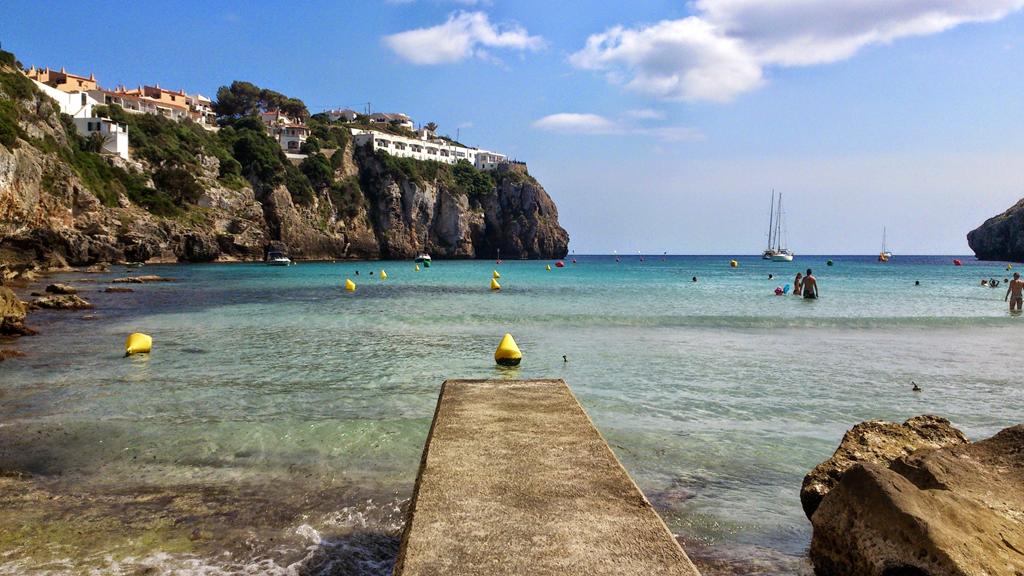
The urbanization of Cala en Porter, located in the south of Menorca, is known for its stunning cove of turquoise waters and golden sand. Accessible by car and public transport, it offers services such as restaurants, bars and stores. The area is well preserved and boasts leisure activities, local events and a family atmosphere, ideal for a relaxing vacation. a Mediterranean paradise! 🌅
Leisure activities


Inland hotels in Alaior
In the town of Alaior visitors can find a wide variety of accommodations, from cozy boutique hotels to modern inland hotels that offer all the comforts. Stroll through its cobblestone streets, discover its historical monuments and enjoy the delicious local gastronomy, Alaior is the perfect place for a relaxing getaway in Menorca!
Encant Boutique Hotel

This charming indoor hotel offers a quiet stay with non-smoking rooms, terrace and free WiFi. Its rooms are equipped with air conditioning, desk, electric kettle, minibar, safe, flat-screen TV and private bathroom with shower.
The hotel provides bicycle rental service and airport transfer. It is 13.4 km from the port of Mahón and 12.2 km from Monte Toro.
Hotel Romandre

Hotel Romandre combines elegance and comfort in a quiet environment. Its modern rooms offer air conditioning, flat screen TV and private bathroom, ideal for a relaxing stay.
Guests value the personalized attention and proximity to local attractions. Perfect for exploring Menorca and enjoying its Mediterranean essence.
Agritourisms
Experimental Menorca

This hotel provides a serene retreat surrounded by nature, with sea views and a decor that combines the traditional with the modern.
Its spacious rooms and excellent service create a cozy atmosphere, ideal for a relaxing getaway. In the middle of the rural landscape, it invites you to connect with nature and enjoy unique moments of tranquility.
Santa Ponsa

Immerse yourself in the Mediterranean paradise by staying at Santa Ponsa Fontenille Menorca. This boutique retreat, surrounded by nature, combines elegance and comfort.
From its rooms with refined decoration to its exquisite local cuisine, it offers an unforgettable experience. Ideal to disconnect, enjoy the tranquility and discover the essence of Menorca, your perfect getaway awaits you here!
Amagatay

The Amagatay Luxury Boutique Hotel – Adults Only, a charming retreat in Alaior, offers an unforgettable stay with its elegant blend of modern luxury and rustic touches.
Surrounded by Menorca’s unspoiled nature, this boutique hotel is perfect for a quiet getaway. Travelers enjoy exquisite rooms, lush gardens and a relaxing pool, all just minutes from the beach.
How to get there
Go to Alaior now (open GPS navigation map)
Explore map of the municipality
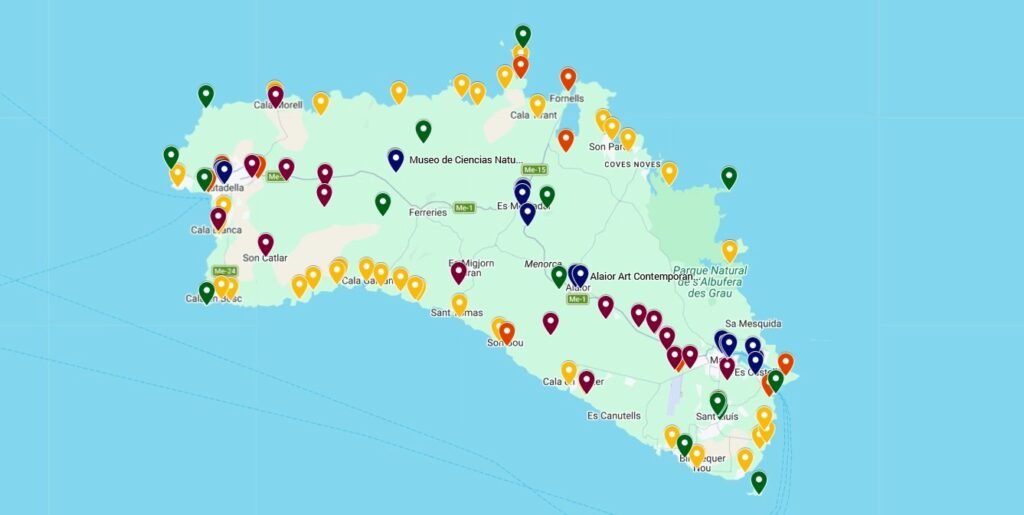
Image gallery